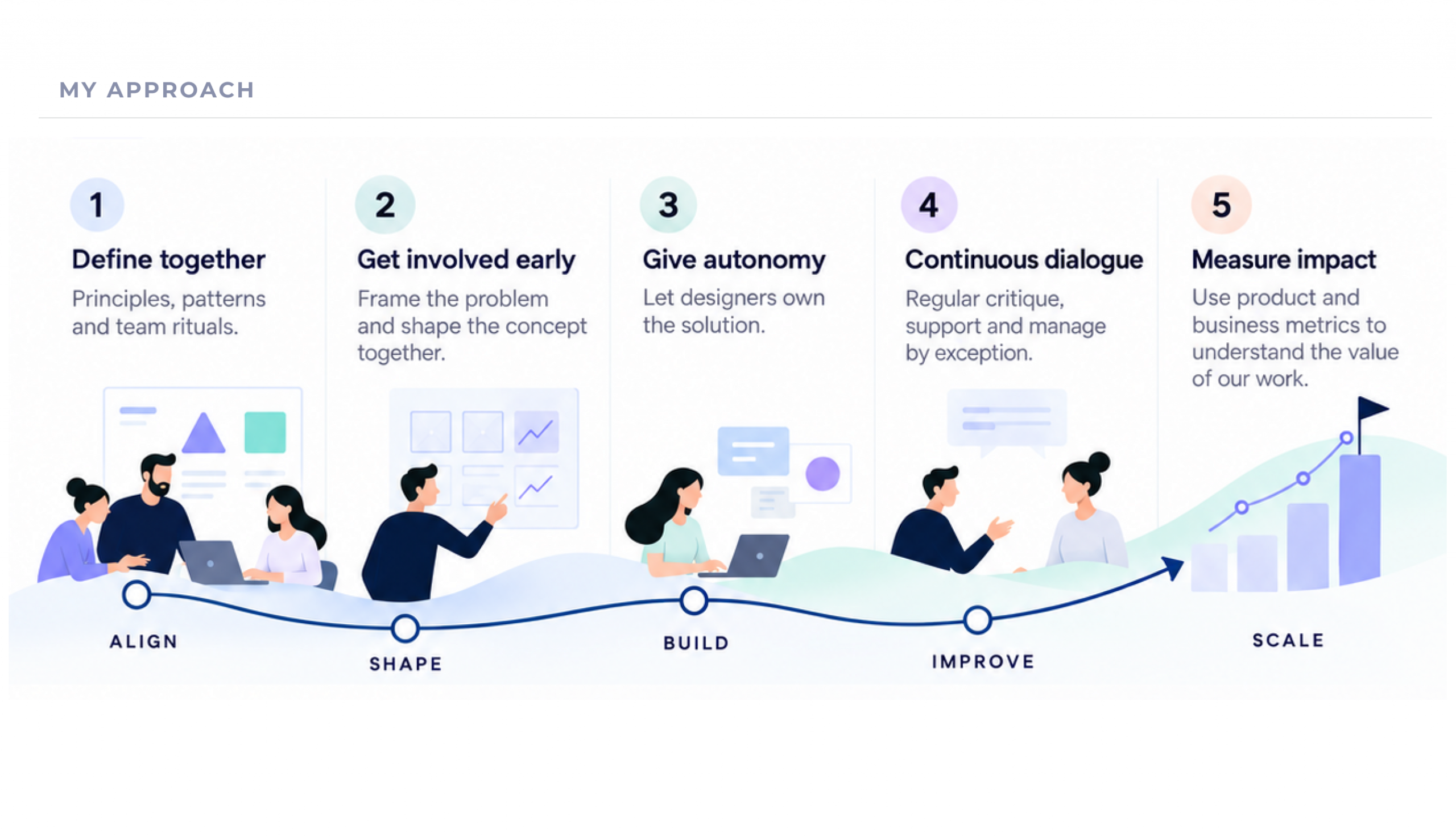
I believe high-performing design teams need more than strong individual designers. They need shared principles, clear direction, autonomy and continuous dialogue.
My role as a design leader is to to create the conditions for designers to do their best work by defining shared principles, getting involved early, giving autonomy, and connecting our work to product and business impact.
I do this by establishing reusable ways of working with the team, grounded in proven usability practices. I stay closely involved when direction and concepts are shaped, then give designers the autonomy to develop and own the solution.
01 — Define principles together
I work with the team to establish principles and reusable rules across design, information architecture, interaction patterns and team rituals. The goal is to create a shared way of working and avoid solving the same problems repeatedly. We ground these principles in established usability knowledge — from Nielsen Norman Group guidelines to cognitive psychology and principles of perception and interaction — rather than relying on individual preferences.
02 — Get involved early, then step back
I stay closely involved in the early stages, when the problem is framed and the concept is shaped. Once the direction is clear, I step back and give designers ownership of the solution.
03 — Manage by exception
Rather than reviewing every decision, I focus my attention where it adds the most value: strategic decisions, complex problems, quality issues or situations where the team needs support.
04 — Maintain continuous dialogue
I keep an ongoing dialogue with designers through regular check-ins, critique and informal conversations. This gives me visibility into the work while creating space for open discussion and feedback.
05 —Measure impact
We work with the team to develop a KPI framework that connects design decisions to product and business outcomes. We identify the metrics that can link improvements in the experience to strategic goals, helping us understand how design contributes to measurable business impact.
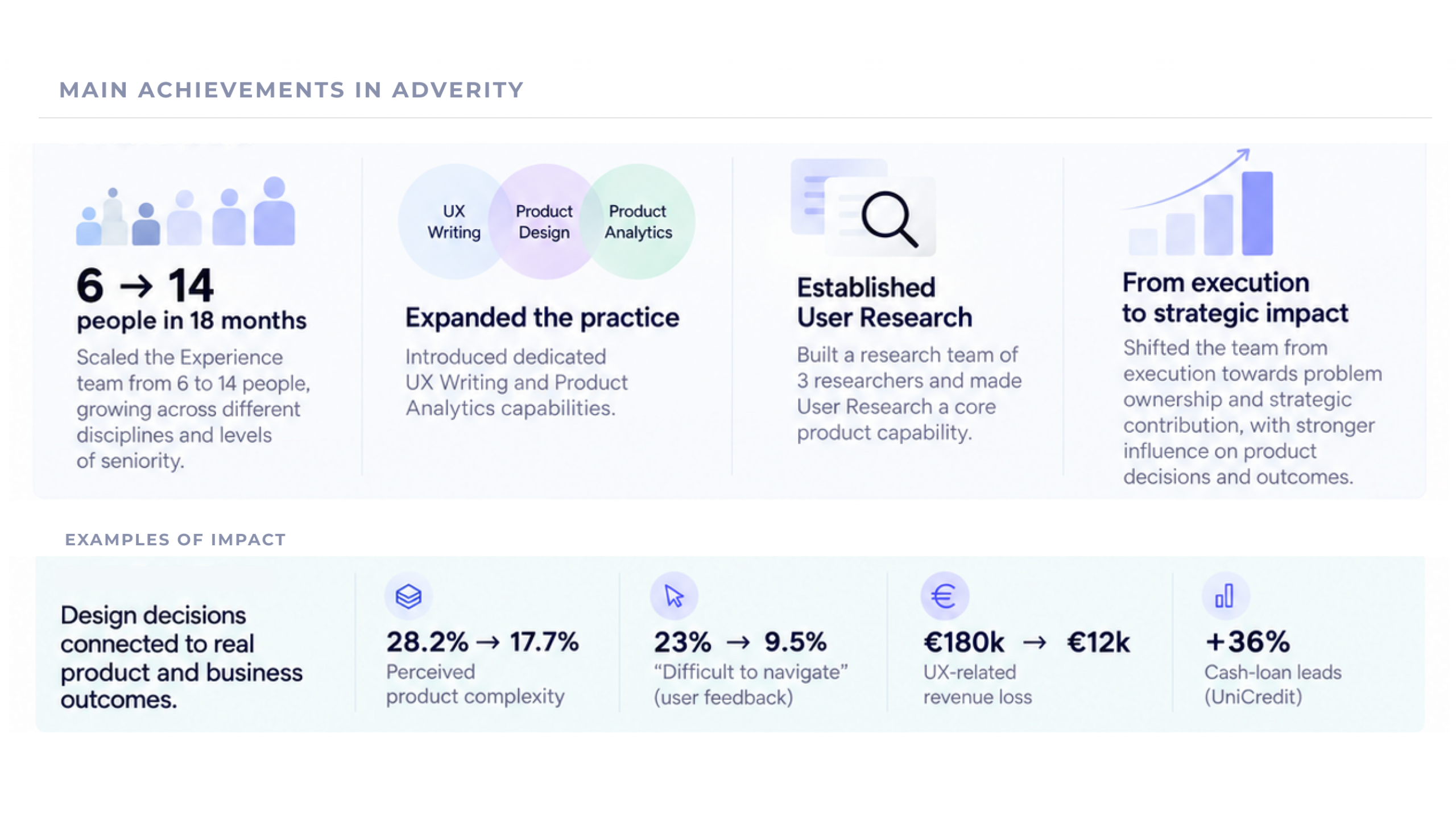
Scaled the Experience team from 6 to 14 people in 18 months, growing the organisation across different disciplines and levels of seniority.
Expanded the practice beyond Product Design, introducing dedicated UX Writing and Product Analytics capabilities.
Established User Research as a core product capability, with a team of 3 researchers embedded across product teams.
Introduced shared design principles, patterns and governance, creating a more consistent way of working across teams.
Built stronger Design–Product–Engineering collaboration, embedding designers earlier in product definition and decision-making.
Created a more autonomous design organisation, shifting the team from execution towards problem ownership and strategic contribution.
Adverity GmbH
from 2020
UX Manager